21 posts tagged with "well-architected"

View All Tags

Controlling Databricks Costs on Azure

· 9 min read
Shpend Kelmendi
Software Engineer & Architect

No one likes surprises on the bill. Whether it is at a restaurant with your date or in a company setting, an unexpectedly high invoice can quickly put us in unnecessary trouble. Explaining to leadership why costs suddenly went up can be okay when it was a conscious decision, but not when something was simply overlooked. That is exactly one of the biggest challenges for our Data Platform Engineering team: cloud and Databricks offer huge opportunities, but costs can rise sharply if you do not pay close attention. What is often missing is the clarity and early steering mechanisms needed to identify the main cost drivers and react in time. Our goal is to enable data teams to unlock the full potential of the platform without unpleasant end-of-month surprises. For us, success means no unexpected costs and cost awareness across all users. After evaluating multiple options, we chose a solution that gives us this freedom without giving up control.

TL;DR

There’s no silver bullet. We combined following components to achieve transparency, responsiveness, and control:

  • Databricks dashboards for visibility into cost drivers → what costs
  • Databricks SQL alerts for proactive notifications when spend deviates → when to act
  • Budget Control for per-user and per-user-group governance → enforce limits
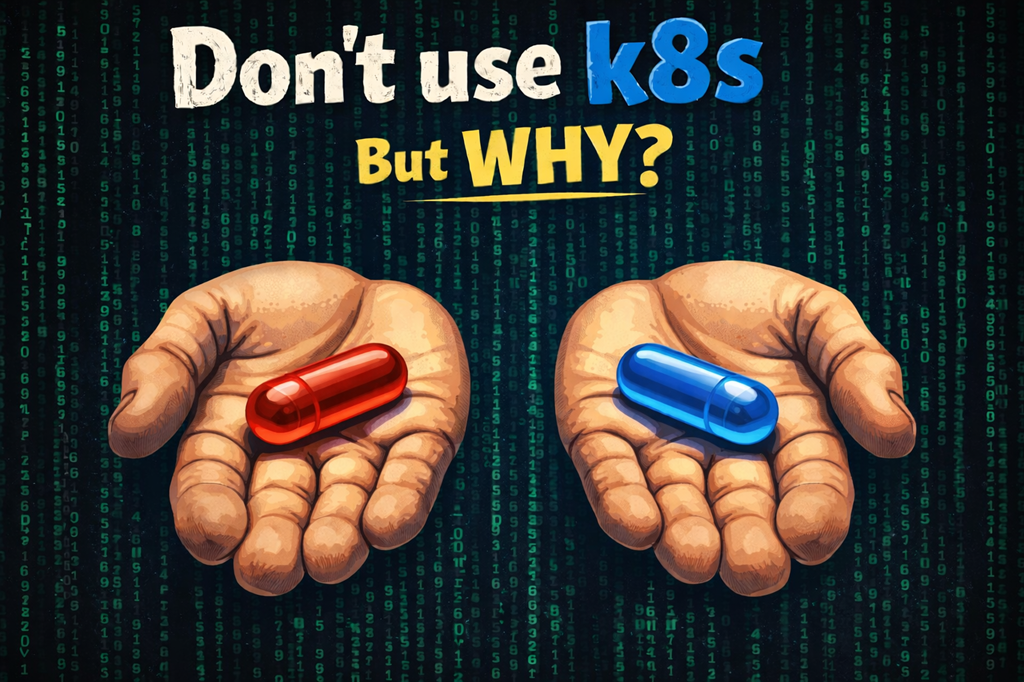
The Kubernetes Matrix: Red Pill or Blue Pill?

· 7 min read
Shpend Kelmendi
Software Engineer & Architect
Joachim Jabs
Senior DevOps Engineer & Cloud Architect

The Red Pill and Blue Pill​

If you haven't seen The Matrix, watch it. It's worth it.

The Matrix is a sci-fi action movie about a hacker named Neo who learns that reality is a simulation run by machines. With Morpheus and Trinity, he struggles to free humans from this illusion. However, he must first make a crucial decision:

Blue pill: comfortable illusion. Red pill: uncomfortable reality.

So what does this have to do with Kubernetes? Picking Kubernetes is the same kind of choice.

Take the Blue Pill if you thinkTake the Red Pill if you think
Kubernetes solves all my problems.Kubernetes is very powerful but adds complexity, which is not necessary for current requirements. Let's start simple.
It's the future - all big companies use it.Big companies have big problems and big teams. Your team with 5 developers has different needs than Google.
No vendor lock-in - we stay flexible.You trade cloud vendor lock-in for Kubernetes ecosystem lock-in. Plus managed k8s still ties you to a provider.
We need it to stay competitive.Competitive advantage comes from solving customer problems, not from adopting the latest technology hype.
It scales infinitely.It can scale, but you need the team, monitoring, and infrastructure to support it. And this is not cheap.
DevOps will be so much easier.DevOps becomes more complex. You need specialized knowledge and significantly more operational overhead.

Which one do you pick?

Quick Azure Cost Management - Budget and Notifications with Bicep and alternatives

· 3 min read
Shpend Kelmendi
Software Engineer & Architect

Managing costs in the cloud is crucial to avoid unexpected expenses.
How many times have I read "Azure just charged me 1k dollars because of a misconfiguration".
Did it happen to you as well? Me too. And I know how stupid you feel after that. Sometimes it is not even our fault. (cough* strange defaults from Azure *cough)

So to avoid that, we can setup budgets and get notified when we reach certain thresholds.
It's important to know which scope you want to set the budget on. It can be at management group level, subscription level or resource group level. Choose the scope you are responsible for and want to monitor costs for.

What are the options? Let's explore them.

Practical guide to organizing Azure resources

· 5 min read
Shpend Kelmendi
Software Engineer & Architect

Organizing Azure resources is one of those rare tasks that sounds straightforward until you actually start doing it.
Suddenly you’re trying to balance cost allocation, security boundaries, governance rules, domain ownership, deployment pipelines, and team autonomy. All while the number of services grows faster than your architecture diagram can keep up.

If designing cloud boundaries feels like organizing a city while it’s still being built, that’s because it is.
And like any good city, Azure needs structure: districts, buildings, addresses, zoning rules, and a way to understand who owns what. Why? Because moving buildings (or Azure resources) is not always easy.

This guide takes a practical look at how to design resource boundaries in Azure—using concepts from Domain-Driven Design (DDD), Team Topologies, CAF, Well-Architected Framework.

Fix expired secrets in Azure DevOps Service Connections

· 2 min read
Shpend Kelmendi
Software Engineer & Architect

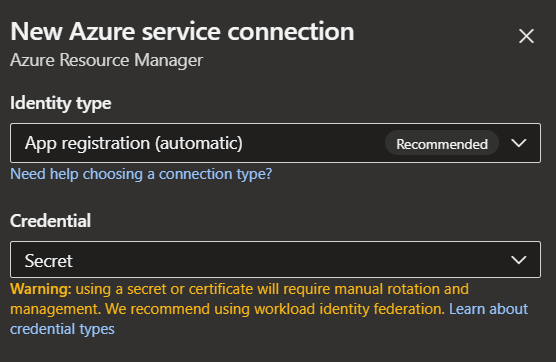
Workload Identity Federation is the recommended approach for Service Connection. So why would I use the old approach with an app registration where I need to rotate the secret by myself? Well, there are some pipeline tasks which doesn't support Workload Identity Federation.
And in this case, you have to use the old approach.
And today was the day of rotation.
And a team member tried to renew the secret but didn't know how to do it, because the problem is still not fixed correctly in the UI.

Let's check the steps to fix it.

When the cloud has a cold: Lessons in resilience

· 6 min read
Shpend Kelmendi
Software Engineer & Architect

October 9th - Azure Front Door takes a nap. Traffic reroutes, dashboards go red, and half the internet suddenly learns what "global edge dependency" really means.

October 20th - an AWS region (US-EAST-1) goes down. Not the apocalypse, just enough to make dashboards bleed red, engineers reach for coffee, and LinkedIn light up with "That's why we use multi-cloud" posts.

October 29th - Azure Front Door stumbles again. Same story, different day. And somewhere in between, a few other providers quietly joined the chaos with their own "we're experiencing elevated error rates" moments.

It's been one of those months when you realize: even the clouds catch colds. The uptime gods don't play favorites - not AWS, not Azure, not anyone.

And that's when Barry O'Reilly's Residuality Theory came to mind again - the idea that what really matters isn't the outage itself, but what's left behind.
The tangled complexity.
The assumptions that didn't hold.
The edge cases you dismissed with a confident, "That'll never happen."

Spoiler: it just did and will again.

Infastructure as Code (IaC) - Your First Steps with IaC in Azure

· 5 min read
Shpend Kelmendi
Software Engineer & Architect

In the cloud world, it’s all about speed, repeatability, and stability. That’s where Infrastructure as Code (IaC) comes in. Many imagine YAML files or PowerShell scripts, but the truth is: Anyone can start with IaC today.

In this post, you’ll learn:

  • What IaC is and why it matters
  • How to get started in Azure – even without deep experience

Microsoft Just Put a Price Tag on Your M2M Tokens for Entra External ID

· 2 min read
Shpend Kelmendi
Software Engineer & Architect

Microsoft just announced pricing for Microsoft Entra External ID M2M Authentication.
Starting November 1, 2025, every access token issued via the Client Credentials Flow will cost $0.001.

The feature isn’t going away — it’s simply entering its “production maturity” phase.
It’s time to pay more or less.

Speech at Basta Spring 2024: Keeping Secrets Secure in Azure: Practical Strategies for Developer Teams

· One min read
Shpend Kelmendi
Software Engineer & Architect

In today's software development landscape, securely handling confidential data is not just a priority but an indispensable quality requirement. In my presentation, I will demonstrate how developer teams can protect sensitive information within the Azure cloud environment. From utilizing Azure Key Vault to leveraging Managed Identity and Infrastructure as Code (IaC) - discover how these techniques not only bolster security but also enhance flexibility in the development process. Join me on this exploration and gain practical, proven strategies.

Link to conference